

Water damage rarely announces itself. It just kind of shows up one day like, “Hey, surprise,” and by then you’re already dealing with soaked cabinets or a ceiling stain that wasn’t there yesterday. And if you’ve ever dealt with it, you know it’s not just the mess. It’s the stress that comes with it. Around Souderton, especially in older homes with aging pipes tucked behind finished walls, the risk feels even more real. Pipes don’t usually fail loudly at first. They whisper. Then they don’t.
That’s where a smart water leak detector makes sense. Not as a fancy upgrade, more like a quiet backup watching things when you’re not thinking about plumbing at all.
And honestly, most people aren’t thinking about plumbing. Until they have to.
Traditional Alarms vs. Smart Monitoring (and Why It Matters)
A basic leak alarm is simple. If water touches it, it screams. That’s it.
It’s fine if you’re home in the kitchen. It’s not fine if you’re out running errands and your washing machine hose decides to give up halfway through the day. A smarter system works differently, and you can see the same basic difference in other types of alarm systems too. Guardian Advanced Solutions’ comparison of smart and traditional alarms shows how connected systems can provide remote notifications and more information instead of simply sounding an alarm when something happens.
A smarter system works differently, though it’s worth being precise: not every “smart” leak detector actually runs artificial intelligence. Some genuinely are. Flo by Moen, for instance, uses what it calls FloSense technology that uses artificial intelligence to analyze and understand your water usage patterns for more precise leak protection.
Phyn Plus takes a related but different approach: Belkin International developed it in collaboration with machine learning researchers at the University of Washington, and it reads pressure changes in your plumbing at a fast clip to build a profile of how your house uses water.
Other products on this list are smart in a simpler sense; they’re Wi-Fi-connected moisture or flow sensors without any learning behavior. That’s not a knock on them. Sometimes straightforward detection is exactly what a budget or a situation calls for. We’ll be specific about which is which as we go.
What all of these systems share is that they watch for things a person standing in the kitchen would never notice: a pressure drop at 3 a.m., water running when the house should be empty, and a drip too slow to see. Some connect to an automatic shutoff valve, which can be the difference between a small repair and a full renovation bill. Water spreads faster than people expect once it gets going; it’s honestly a little unsettling to picture.
Smart Water Leak Detector Comparison
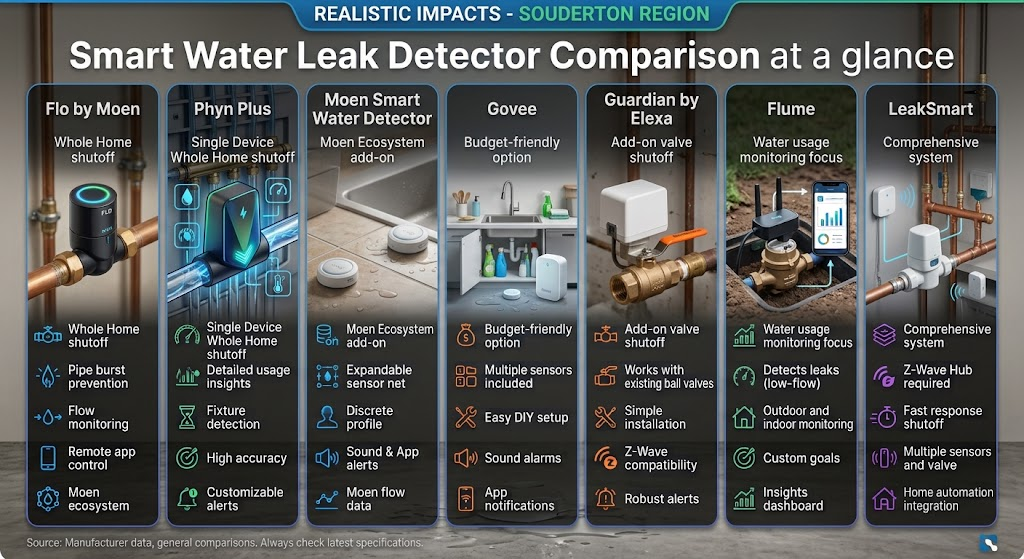
| Device | Type | Shutoff | AI / Learning |
| Flo by Moen | Whole-home | Yes | Yes (FloSense) |
| Phyn Plus | Whole-home | Yes | Machine-learning pressure analysis |
| Moen Smart Water Detector | Point sensor | No (triggers Flo shutoff if paired) | No |
| Govee | Point sensors | No | No |
| Guardian by Elexa | Whole-home + sensors | Yes | No |
| Flume | Meter-based | No | No |
| LeakSmart | Whole-home | Yes | No |
Flo by Moen Smart Water Monitor & Shutoff
Flo by Moen keeps coming up whenever people talk about whole-home leak protection, and there’s a reason. It installs on your main water line and runs constant micro-checks in the background. Internal sensors monitor the actual water moving through your home and distinguish between typical usage and a leak or burst pipe, rather than relying on ultrasound guesswork.
It’s genuinely sensitive, too. The system’s MicroLeak technology can detect leaks as small as a single drop of water per minute, which sounds minor until you multiply it by weeks. Moen also reports that Flo decreases water damage claims by 96%, and 60% of homeowners are notified of a leak within the first 30 days of installation that they didn’t know they had a number worth sitting with because it means most homes already have a small problem hiding somewhere.
Installation isn’t casual, though. It runs around $549.98 USD, and professional installation is recommended, typically taking a few hours. Neither is repairing soaked flooring.
Phyn Plus Smart Water Assistant
Phyn Plus takes a more granular approach. It samples pressure in your plumbing 240 times every second, reading the distinctive signature of each fixture in the house so over time it can tell your dishwasher apart from your shower and flag water running at 3 a.m. when nobody should be awake.
It’s priced at $579.99 for the current generation, and earlier versions have been listed closer to $699. Installation needs a licensed plumber, since the main water line to your home is cut where the device is installed. Some insurers, including a Nationwide bundle in parts of California, have subsidized installation to make the upfront cost easier to swallow.
Moen Smart Water Detector (Small but Useful)
Not everyone wants a full system right away. Sometimes you just want coverage in the risky spots under sinks, near the water heater, and behind the washing machine.
This is a plain point sensor: it monitors moisture, humidity, and room temperature, and it can trigger an automatic shutoff if it’s paired with a Flo by Moen main-line valve. On its own, it just alerts you. It runs on a CR123. A lithium battery is rated to last up to two years, and it costs around $57. No learning, no pattern recognition, just a reliable tripwire in the places that matter most.
Govee Smart Leak Detector
Govee is the budget option, and it doesn’t pretend to be anything else. It skips flow analysis entirely and just watches for contact with water.
Multiple sensors connect through a WiFi gateway that supports up to 10 sensors at once, and when water is detected, it triggers both an app notification and a physical alarm. That alarm is a loud 100 dB adjustable siren, which is genuinely startling in a quiet house. No monthly fee, no learning curve. For someone trying to prevent water damage without a big upfront investment, that’s often enough.
Guardian by Elexa (the One People Overlook)
Guardian pairs a main-line valve controller with placed sensors, and it’s a DIY-friendly install: no plumber, no pipe cutting. The leak detectors run on a 15-year battery and sense water from both the top, for drips, and the bottom, for flooding.
One feature that doesn’t get talked about enough: Guardian can automatically close the water main not just for a detected leak, but for freezing temperatures or earthquake vibrations too, which matters for older Souderton homes where pipes sometimes run through unheated crawl spaces or exterior walls with little insulation.
Context for why any of this matters: Elexa cites more than 14,000 water damage claims filed per day in the U.S., averaging between $6,000 and $15,000 each. That’s not a marketing number pulled from thin air; it’s the scale of the problem these systems exist to solve.
Flume Smart Water Monitor
Flume takes a completely different approach; it straps to your water meter instead of cutting into a pipe. It’s a roughly 10-minute installation with no plumber, wires, or pipe cutting required.
It won’t shut the water off; that’s the trade-off for the easy install, but it will flag unusual activity. One LADWP customer’s install log is a good example of what that looks like in practice: after setup, the app revealed morning sprinklers using almost 250 gallons in just 45 minutes, prompting a closer look at the irrigation system for leaks. That’s the kind of thing a person would never catch just glancing at a water bill once a month.
LeakSmart Whole-Home System
LeakSmart’s whole pitch is speed. The valve connects to the main water supply and automatically shuts off the water in less than five seconds once a leak is detected.
It also plays well with existing smart-home setups; it integrates with Nest, Wink, Iris, Google Assistant, and Amazon Alexa and supports up to 30 wireless sensors placed around the house for broader coverage. One owner’s story is worth mentioning here: he installed LeakSmart after his sister and brother-in-law came home on Christmas Day to water running down their stairs from plumbing that had been run outside the home’s insulation; repairs cost over $10,000. It’s the kind of story that explains why “whole-home shutoff” stops sounding like overkill pretty quickly.
Point Sensors vs. Whole-Home Systems: The Real Decision
This is where most people pause. Point sensors are cheap and easy; you place them where leaks are most likely, and they catch visible problems early. A whole-home system watches everything through the main line and can catch slow leaks you’d never physically see until damage shows up. But it costs more, and installation is more involved.
For most Souderton homes, a mix works best: one system on the main line, plus a few point sensors in the highest-risk spots. That combination gives solid coverage without overthinking it.
Insurance and Savings (a Quiet Bonus)
Water damage and freezing account for roughly 27–29% of all homeowners insurance claims, which is why insurers actually have skin in the game here. Depending on your carrier and device, smart water sensors, especially ones with automatic shutoff, can earn 10–13% in premium credits, and some companies go further: Nationwide, for example, has offered free detectors with a 10% discount attached, and several carriers subsidize installation costs directly. It’s worth a call to your provider before you buy anything, since the specifics vary quite a bit by company and state.
Final Thought: When Tech Isn’t Enough
A smart leak detection system can warn you. It can even shut the water off. But it can’t fix the problem. It won’t repair a broken pipe behind a wall, and it won’t locate a slab leak precisely.
Speed matters more than people assume, too. According to the EPA’s guidance on water damage cleanup and mold prevention, mold growth can begin within 24 to 48 hours of water exposure, a short window between “we caught it” and “we have a bigger problem now.”
In older homes around Souderton, issues don’t always show themselves clearly. Sometimes it’s a slow pressure drop. Sometimes it’s nothing visible at all. If your system keeps flagging issues and you can’t find the source, that’s usually the point where calling a professional from Royal Penguin Plumbing makes sense. Not later. Sooner rather than later, because water damage rarely gets cheaper with time.