
You turn on the kitchen faucet on a bitter morning and get a dribble. Or you head to the basement and find frost creeping along a pipe by the foundation wall. Water expands as it freezes, and that pressure can split a pipe, so the next few minutes matter. The good news is that learning how to fix frozen pipes mostly comes down to patience: an open faucet, gentle heat, and a quick check for leaks.
This guide covers how to recognize a freeze, what to do first, how to thaw a pipe safely, when to stop and call a plumber, and how to keep it from happening again.
How Do You Know Your Pipes Are Frozen?
The classic sign is a faucet that gives you a trickle or nothing at all. The American Red Cross says to suspect a frozen pipe in that situation, and it names exterior walls and the point where your water service enters through the foundation as likely trouble spots.
Other clues include:
- Frost or ice on exposed pipes in a basement, crawl space, garage, or attic
- Weak flow at one fixture, or at several at once
- Gurgling, banging, or other odd sounds when you open a tap
- A bulge, crack, or damp patch on the pipe or the wall or ceiling beside it
Not every plumbing problem is a freeze. A clogged aerator, a failing well pump, a water heater issue, or a utility outage can look similar. Weather is the tiebreaker. If it has been well below freezing and the weak flow is on a line near an outside wall or an unheated space, a freeze is the likely culprit. If the weather is mild, look elsewhere before you reach for a hair dryer.
What Temperature Do Pipes Freeze At?
Water freezes at 32°F, but the pipes in your walls don’t all freeze the moment the thermometer hits that number. Texas A&M AgriLife Extension says water pipes can freeze and burst once the outside temperature reaches 20°F or below. Think of 20°F as a warning line, not a guarantee.
Whether a particular pipe freezes depends on where it runs, how much insulation surrounds it, how much wind or draft reaches it, whether the heat stays on, and how long the cold lasts. Hot water lines can freeze too when the water in them isn’t moving.
Duration matters as much as the number. During Philadelphia’s deep freeze in February 2026, a master plumber told 6abc that the region is built for freezing temperatures, just not for freezing temperatures that last as long as these did.
What to Do for Frozen Pipes Right Away
Open the faucet on the affected line and leave it open. As the ice starts to melt, water begins to move, and the Red Cross notes that running water helps melt the rest.
Next, find your main water shutoff. A frozen pipe may already be cracked and will leak once it thaws, so you want to be able to close that valve fast. If you suspect a burst, or you’ll be away from the house while the pipe thaws, shut the main off.
Then look the pipe over. A visible crack, bulge, or wet spot means thawing isn’t the right next step. Shut the water off and call a plumber. Also open the other faucets in the house, since if one pipe froze, others may have too.
How to Safely Thaw Frozen Pipes Yourself
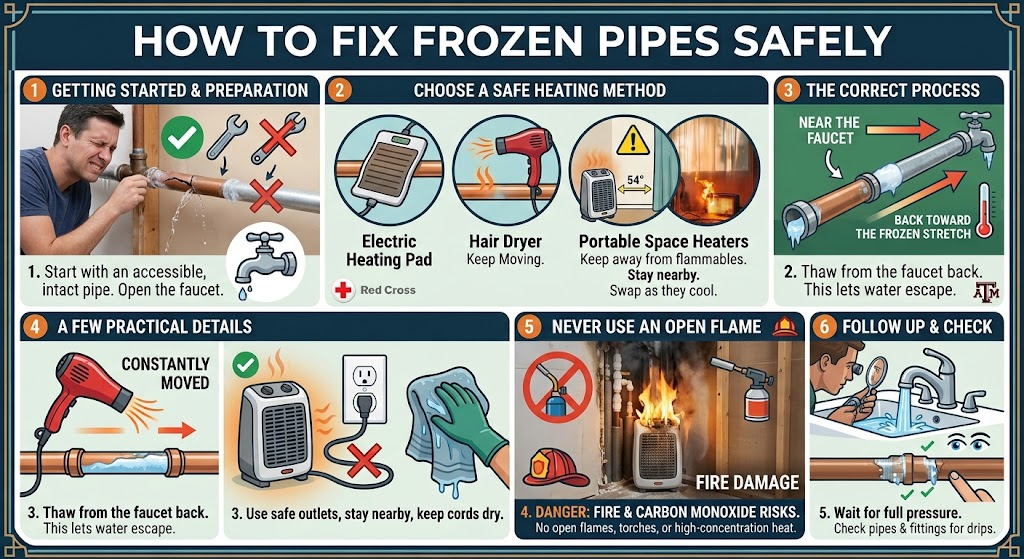
If you’re working out how to fix frozen pipes yourself, start with a pipe that’s intact and within easy reach. The Red Cross lists four options: an electric heating pad wrapped around the pipe, a hair dryer, a portable space heater kept away from anything flammable, or towels soaked in hot water.
Begin at the section closest to the faucet and work back toward the frozen stretch, so melting water has a path out. Keep the faucet open the whole time and keep heating until full pressure returns. Be patient, because rushing it with more heat is how pipes get damaged.
A few practical details help. Keep a hair dryer moving rather than parking it on one spot. Plug a space heater into a proper wall outlet, give it clear space, and stay nearby. The plumber in the 6abc story warned about fire hazards from poorly chosen outlets. Swap wet towels as they cool, and keep cords dry.
Never use an open flame, torch, propane burner, or other direct flame to thaw plumbing. The Red Cross specifically rules out blowtorches, kerosene or propane heaters, and charcoal stoves, and Texas A&M adds that they are a serious fire hazard that can release lethal carbon monoxide. Concentrated heat can also scorch the framing and insulation around a pipe, weaken soldered joints, and damage plastic lines, and you can’t see behind a wall to know what’s heating up.
Once water flows normally, check the pipe and fittings for drips and test the other fixtures.
What Happens If a Frozen Pipe Bursts?
Ice takes up more room than liquid water, and the pipe has nowhere to go. That pressure is why both metal and plastic pipes can split. The tricky part is that a cracked pipe often doesn’t leak while it’s frozen, because the ice plugs the break. The moment water returns is when you find out.
Signs of burst pipes include:
- Water spraying or dripping from a crack
- Stains, bubbling paint, or sagging on a wall or ceiling
- Water pooling in a cabinet, basement, or on the floor
- The sound of running water when nothing is on
If you see any of that, shut off the main water valve first. Move belongings off wet floors, stay clear of outlets and the electrical panel if water is near them, and call for emergency plumbing services. The Texas Department of Insurance advises turning the water off at the main and moving valuables off the floor and warns that an insurer may deny a claim if you don’t protect the property.
Thawing and repairing are different jobs. Thawing restores flow; it doesn’t fix cracked pipes. A split section has to be cut out and replaced, and a plumber will usually check nearby runs because a freeze can damage more than one spot. Slow leaks can also surface days later, so a quick pass through our guide to checking your home for hidden water leaks is worth the time after any hard freeze.
Two Realistic Examples
Philadelphia, February 2026. 6abc reported that one master plumber’s phone was “ringing nonstop” after days of sub-freezing weather. One South Philadelphia homeowner found her basement ankle-deep in water, and a Northeast Philadelphia burst line soaked and froze a family’s stored belongings. In Point Breeze, a resident was using a space heater and hair dryer on pipes that had stopped delivering hot water. The City of Philadelphia later noted it was the first winter since 2018 with more than a week of freezing temperatures. The lesson: long cold stretches overwhelm pipes in basements and exterior walls, and the shutoff valve is the first thing to find.
Texas, February 2021. The Texas Department of Insurance reports that Winter Storm Uri produced more than 450,000 claims and over $8 billion in insured losses, much of it from water escaping broken pipes. WFAA found State Farm had received about 75 busted-pipe reports in all of 2020 but nearly 29,000 claims within days of the storm, and the insurer said thawing exposed damage that had been hidden. The lesson: watch the pipe closely as it thaws, and be ready to shut the water off.
When to Worry About Frozen Pipes
Stop the DIY approach and call a professional when:
- The frozen section is inside a wall or ceiling, or you can’t reach it
- You can see a crack, a bulge, or a wet spot
- Water starts leaking while you thaw
- Several fixtures are affected, or you can’t tell which section is frozen
- Safe heat isn’t restoring flow
- Water has already reached floors, ceilings, or anything electrical
The Red Cross gives the same advice: if you can’t find the frozen area, can’t reach it, or can’t thaw it, call a licensed plumber. Royal Penguin Plumbing handles emergency plumbing repairs for homes in Bucks and Montgomery counties, and our leak detection and repair service can track down a leak inside a wall before it turns into a bigger repair.
How to Prevent Frozen Pipes in Winter
Frozen pipes in winter are mostly a preparation problem, and each fix works for a simple reason.
Insulate Exposed Pipes
The Insurance Institute for Business & Home Safety (IBHS) recommends wrapping pipes and faucets in unheated or minimally heated areas, including attics, crawl spaces, and exterior walls. Insulation slows heat loss, buying time before water gets cold enough to freeze.
Seal Drafts
IBHS also suggests caulking exterior gaps and weatherstripping doors and windows until you can’t see daylight. A narrow stream of cold air aimed at a pipe can freeze it even when the rest of the house is warm.
Keep the Heat Steady
The Red Cross advises the same thermostat setting day and night during severe cold. You may pay a bit more, but a burst pipe costs far more. If you’re leaving town, keep the heat on at 55°F or higher.
Open Cabinet Doors
Under-sink pipes on exterior walls sit in a cold pocket, and open doors let room air reach them. Move cleaning products out of children’s reach first.
Let a Faucet Drip
The Red Cross says even a trickle through an exposed line helps prevent freezing. Moving water is harder to freeze, though the plumber on 6abc cautioned that once a pipe is frozen, dripping won’t do much.
Protect Outdoor Faucets
Disconnect and drain hoses and cover the spigot. IBHS notes that homes built before 2010 typically lack frost-proof faucets, so shut the interior valve to the outside faucet and insulate it. Water trapped in an exterior line has nowhere to expand.
Thaw Gently, Stop Early, Plan Ahead
Spotting the signs early, opening a faucet, and applying gentle heat are the heart of how to fix frozen pipes without causing more damage. Keep flames out of it, watch for leaks as the ice melts, and shut the main water off at the first sign of a burst. Then insulate, seal drafts, and keep the heat on before the next cold snap.
If you can’t reach the frozen section, can’t get it to thaw, or can’t find a leak, contact Royal Penguin Plumbing or call (215) 720-2721, and we’ll help get the water running again.