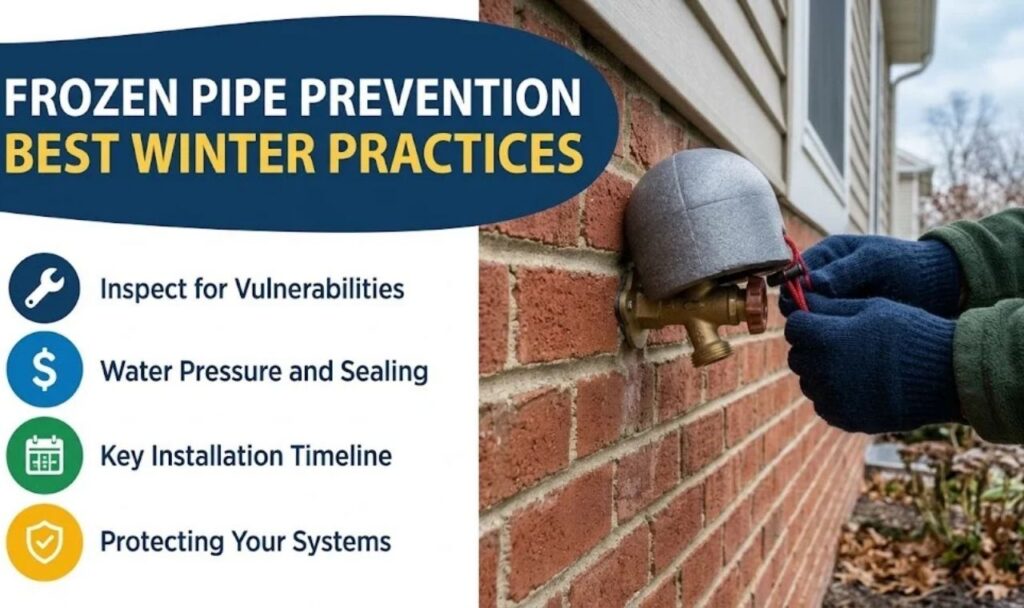
Pennsylvania homeowners should winterize outdoor faucets before freezing weather arrives. Disconnect garden hoses, inspect the faucet for leaks, and, if you have a conventional outdoor spigot with a dedicated indoor shut-off valve, turn off its water supply and drain the line according to your plumbing system’s instructions. An insulated outdoor faucet cover adds protection, but it cannot replace proper draining when that is required.
Winterizing matters because water trapped inside a faucet or supply pipe can freeze, expand, and damage plumbing. The resulting leak may remain hidden until the ice melts.
If you are considering faucet installation near me because an older outdoor spigot leaks or freezes repeatedly, replacing it with a properly installed frost-free model may be worth discussing with a plumber.
Why You Should Winterize Outdoor Faucets Before Winter
Outdoor faucets are exposed to cold air, making them vulnerable to freezing when water remains in the fixture or connected plumbing. The risk increases when pipes run through unheated garages, crawl spaces, basements, or exterior walls.
Water expands as it freezes. If ice forms inside a section of plumbing where water cannot move freely, pressure can build and damage the pipe, faucet, or connections. A split may occur inside a wall rather than directly at the outdoor spigot.
This explains why a faucet can appear fine during freezing weather but start leaking when temperatures rise and the ice melts.
Pennsylvania’s winter conditions vary by region and elevation, so there is no single temperature that guarantees every outdoor faucet will freeze. Pipe placement, insulation, exposure to wind, and faucet design all affect the risk.
Preparing early helps you:
- Reduce the chance of frozen outdoor pipes.
- Identify leaks before freezing weather arrives.
- Protect faucets and plumbing connections.
- Avoid discovering concealed water damage after a thaw.
- Determine whether an older faucet needs repair or replacement.
Do not wait until a prolonged cold spell to inspect your outdoor plumbing. Complete the basic winterization steps before the first hard freeze.
What You Need Before Winterizing an Outdoor Faucet
Most homeowners can prepare for routine winterization with a few basic items:
- Access to the indoor shut-off valve, if the faucet has one.
- A small bucket or container to catch draining water.
- A properly sized insulated outdoor faucet cover.
- The manufacturer’s instructions for a frost-free faucet, if applicable.
- A flashlight for inspecting exposed pipes and connections.
Locate the correct shut-off valve before turning anything. It is often in a basement, utility room, or crawl space near the pipe leading to the outdoor faucet.
If you cannot identify the correct valve, do not shut off a random pipe or force a handle that will not move. A plumber can help determine how the line is configured.
How to Winterize an Outdoor Faucet Step by Step
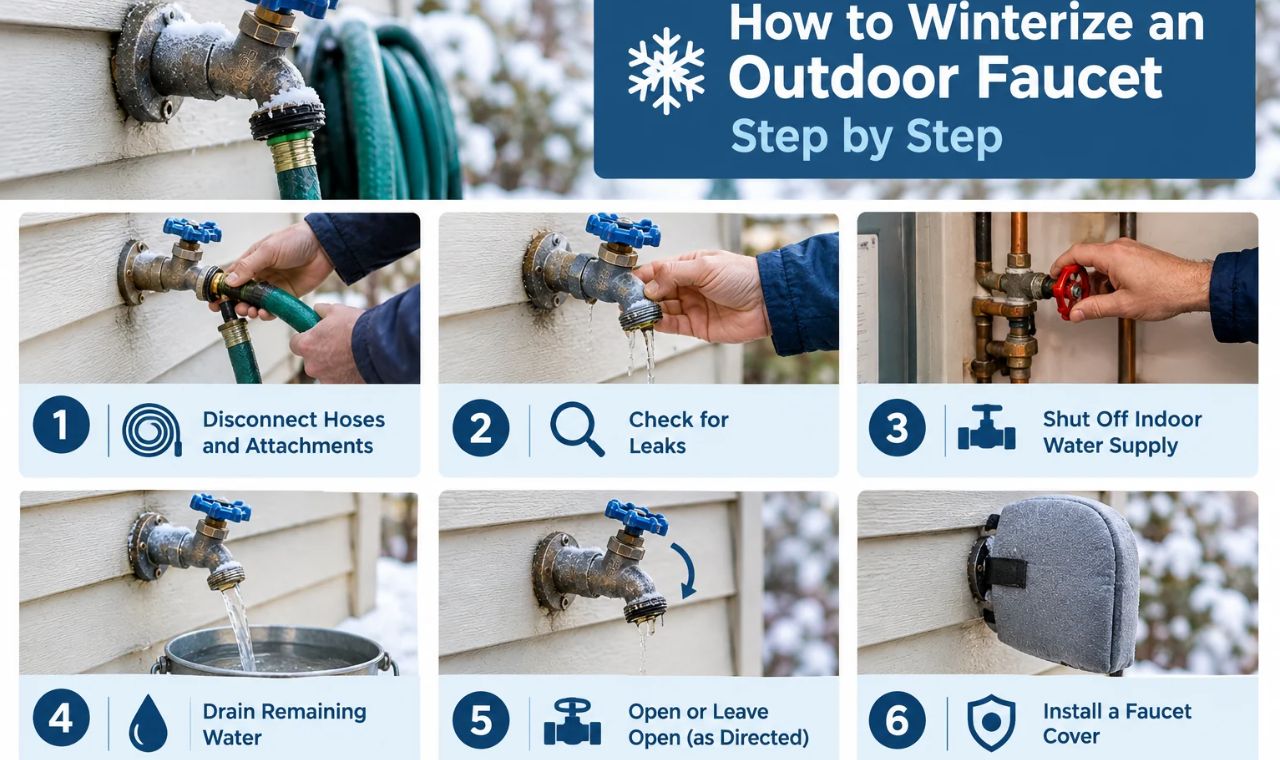
Step 1: Disconnect Garden Hoses and Attachments
Remove all garden hoses, hose splitters, timers, and other attachments connected to the outdoor faucet.
Water can remain trapped inside a hose or fitting. If the attachment prevents a frost-free faucet from draining properly, freezing can damage the faucet or connected pipe.
Drain your hoses and store them somewhere sheltered. Check every outdoor faucet, including those behind garages, along side walls, and near basement entrances.
Step 2: Inspect the Outdoor Faucet for Leaks
Turn the faucet on briefly when temperatures are above freezing and check its operation. Look for:
- Water dripping from the spout after you turn it off.
- Cracks around the faucet body or threaded connection.
- Corrosion or loose fittings.
- Damp patches on the exterior wall near the pipe entry point.
- Water appearing around the faucet when it operates.
A leaking faucet should be repaired before winter. Simply installing a cover will not fix a damaged valve or prevent every possible leak.
If water appears to be coming from inside the wall, avoid dismantling the fixture. The problem may involve a concealed pipe or connection that needs professional inspection.
Step 3: Shut Off the Indoor Water Supply
For a conventional outdoor faucet with a dedicated shut-off valve, locate the valve inside the house. It may be near the point where the water line branches toward the exterior wall.
Close the valve gently. If it has a handle that will not move, do not force it with pliers or another tool. A damaged valve can create a leak or make it difficult to isolate the line.
Some homes do not have a separate shut-off valve for every outdoor faucet. Others use frost-free faucets that are designed to drain without the same seasonal shut-off procedure.
If you cannot identify your setup, consult the manufacturer’s instructions or a plumber before proceeding.
Step 4: Open the Outdoor Faucet to Drain Remaining Water
After closing the indoor shut-off valve on a conventional faucet, open the outdoor faucet to let the water remaining in the line drain into the container or onto the ground.
If the indoor shut-off valve includes a small drain or bleed port, follow its instructions to release water trapped between the valve and the outdoor faucet. Place a bucket underneath the port before opening it.
Do not assume that opening the outdoor faucet alone empties every part of the line. The plumbing layout, pipe slope, and location of the shut-off valve affect drainage.
If water continues flowing steadily after the supply valve is closed, the valve may not be sealing properly. Have the system checked rather than assuming the line is empty.
For additional guidance, the Macon Water Authority’s winterization instructions explain how to disconnect hoses and drain conventional outdoor faucet lines.
Step 5: Close or Leave the Faucet Open as Appropriate
Should outdoor faucets be left open during winter? The answer depends on the faucet type and the manufacturer’s instructions.
For a conventional faucet whose indoor supply has been shut off and drained, leaving the outdoor faucet open may help prevent pressure from building in the isolated section. Some plumbing configurations and manufacturers specify a different final handle position.
For a frost-free model, follow its instructions. Do not automatically apply the same shut-off and drainage process used for a conventional faucet.
The key is to ensure that the water supply is properly isolated where required and that residual water has a way to drain. If the correct procedure is unclear, get advice before leaving the system unattended.
Step 6: Install an Insulated Outdoor Faucet Cover
Fit an insulated cover over the faucet and secure it according to the product instructions. Most covers use foam insulation and a fastening mechanism to limit exposure to cold air.
Choose a cover that fits snugly against the exterior wall. Check it occasionally to make sure it remains secure after strong winds or heavy weather.
An outdoor faucet cover is an additional layer of protection, not a replacement for draining a conventional faucet line when necessary. A cover also cannot correct an incorrectly installed frost-free faucet or protect a pipe that remains vulnerable inside an unheated wall.
How to Winterize a Frost-Free Outdoor Faucet
A frost-free hose bib is an outdoor faucet designed to shut off the water farther inside the building, where temperatures are generally warmer. Its long internal stem places the valve seat away from the exposed end of the faucet, allowing the outer section to drain when the faucet is properly installed and used.
These models reduce freezing risk, but they are not immune to damage.
To prepare a frost-free faucet for winter:
- Disconnect all hoses and attachments.
- Check the faucet for drips, visible cracks, and other damage.
- Confirm that water drains from the faucet as intended when the supply is used normally.
- Follow the manufacturer’s instructions for winter protection and handle position.
- Add a suitable insulated cover if recommended or appropriate for the installation.
Proper installation matters. A frost-free faucet generally needs a slight downward slope toward the exterior so water can drain out. If it slopes inward, is damaged, or has a faulty valve, water may remain trapped.
A hose left attached is another common problem because it can prevent drainage. Even a faucet marketed as freeze-proof can suffer damage under the wrong conditions.
If your faucet repeatedly freezes despite following the instructions, a plumber can check its slope, valve operation, and the condition of the pipe inside the wall.
Common Outdoor Faucet Winterization Mistakes
Avoid these mistakes when preparing your outdoor plumbing for freezing weather.
- Leaving a hose attached: Disconnect hoses, splitters, and timers so water can drain from the faucet properly.
- Skipping the indoor shut-off: If your conventional faucet requires seasonal isolation, use the correct dedicated valve and drain the line.
- Relying only on a cover: Insulation adds protection but does not remove trapped water.
- Forcing a stuck valve: Stop if a valve is corroded or difficult to operate. Have it inspected rather than risking a broken handle or connection.
- Assuming frost-free means freeze-proof: Remove hoses and follow the manufacturer’s instructions even with modern faucets.
- Ignoring a slow drip: Repair leaks before freezing weather when possible.
- Using unsafe heating methods: Never use a blowtorch, open flame, or other high-heat device to thaw a frozen pipe.
The University of Illinois Extension’s guide to winterizing outdoor plumbing explains why removing hoses matters even when a home has frost-proof spigots.
Signs Your Outdoor Faucet or Pipe May Be Frozen
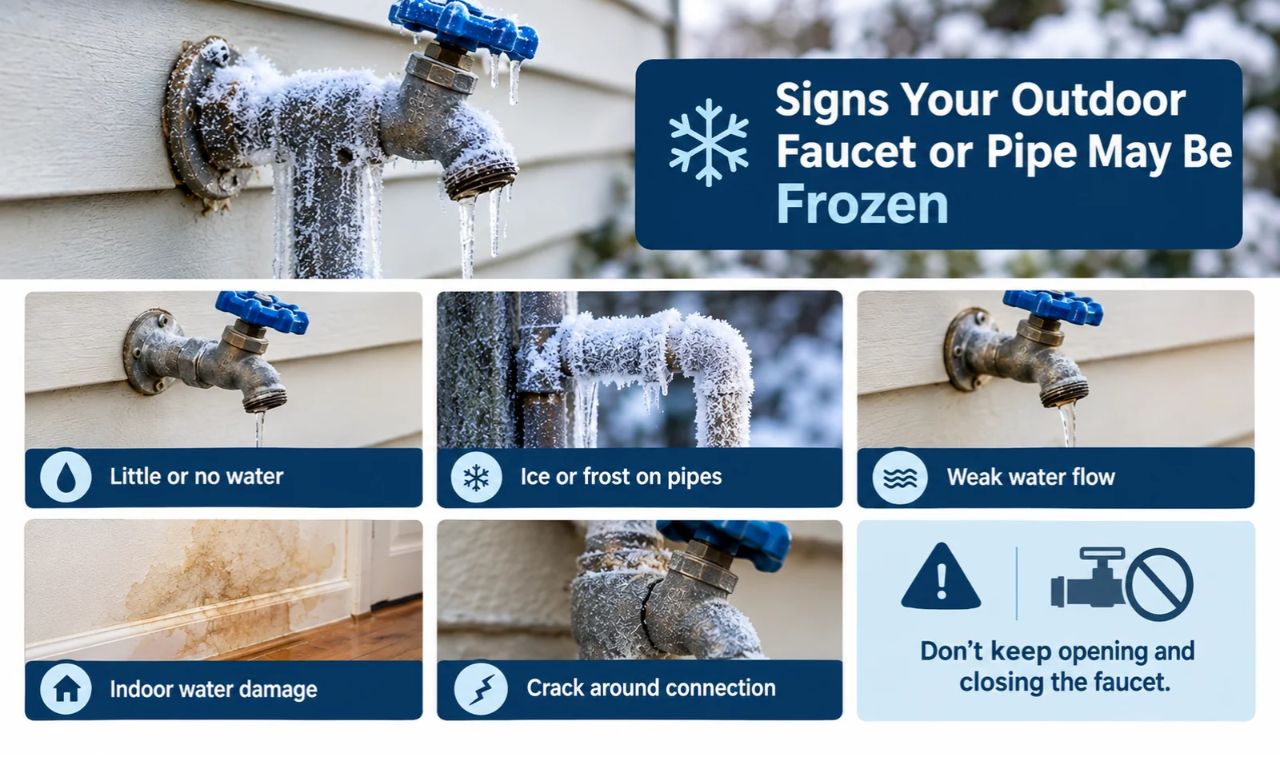
- Little or no water comes out when you open the faucet.
- Ice or frost appears on exposed plumbing.
- Water flow becomes weak during a cold spell.
- The faucet or nearby pipe begins leaking after temperatures rise.
- Dampness, staining, or water damage appears inside the house near the exterior wall.
- A visible crack develops around the faucet or pipe connection.
These symptoms do not always mean the pipe is frozen. A closed valve, clogged faucet, failed washer, or other plumbing fault can also restrict water flow.
If the faucet stops working during freezing weather, avoid repeatedly opening and closing it in an attempt to force water through. Check accessible areas for obvious problems, but do not remove wall coverings or dismantle pipes to find the blockage.
Remember that damage may become visible only after the ice melts. If you suspect a concealed frozen pipe, arrange a professional assessment before using the faucet again.
What to Do if an Outdoor Faucet or Pipe Freezes
If you suspect frozen plumbing, stop using the affected faucet and check for signs of leakage where it is safe to do so.
Use these precautions:
- Check for visible damage. Look for cracks, dripping water, or damp areas without touching icy or unsafe plumbing.
- Avoid open flames. Never use a blowtorch, charcoal heater, or other open-flame device to thaw pipes.
- Do not dismantle concealed plumbing. Pipes inside walls or inaccessible crawl spaces need professional assessment if they are suspected to be frozen.
- Watch for leaks during thawing. A cracked pipe may start leaking as ice melts, even if it appeared intact during the freeze.
- Shut off the main water supply if a pipe bursts. Do this only if it is safe to reach the valve. Contact a qualified plumber promptly.
If water is near electrical outlets, wiring, or electrical equipment, stay away from the affected area and seek appropriate emergency assistance. Do not enter standing water that may be electrically energized.
For broader cold-weather preparation, the Philadelphia Water Department’s frozen-pipe prevention guidance covers pipe insulation, shut-off valves, and outdoor faucet precautions.
When Should You Call a Plumber for Outdoor Faucet Installation or Repair?
Some winterization tasks are straightforward, but damaged fixtures and concealed pipe problems may need professional attention.
Consider contacting a plumber if:
- Your outdoor faucet leaks or has visible cracks.
- The indoor shut-off valve will not operate safely.
- A pipe may have frozen inside a wall or crawl space.
- Your frost-free faucet freezes repeatedly.
- You need a new frost-free hose bib installed.
- You cannot determine how to isolate or drain your outdoor supply line.
- Water appears inside the home after a freeze.
If you are searching for faucet installation near me, look for a plumbing professional who can explain the installation options, assess the existing pipework, and provide a clear estimate before starting the job.
Ask whether the proposed faucet is suitable for your plumbing layout, whether the line will drain correctly, and whether any damaged pipe or shut-off valve needs attention. Check relevant licensing requirements, insurance, and the scope of the quoted work.
Homeowners considering faucet installation in Pennsylvania should also discuss exposure to cold weather, wall insulation, and access to shut-off valves. A correctly selected and installed faucet can reduce freezing risk, but the surrounding plumbing still needs suitable protection.
Royal Penguin Plumbing lists faucet installation among its services. Homeowners can review its general plumbing services to learn more about available plumbing assistance.
Preparing Your Outdoor Plumbing for Pennsylvania Winters
Use this checklist before freezing temperatures arrive:
- Disconnect and drain all garden hoses.
- Inspect each outdoor faucet for leaks, corrosion, or cracks.
- Identify the correct indoor shut-off valve for conventional faucets.
- Drain conventional faucet lines when the plumbing setup requires it.
- Operate drain or bleed ports according to the manufacturer’s instructions.
- Fit suitable insulated faucet covers.
- Check exposed pipes in unheated basements, garages, and crawl spaces.
- Review the instructions for frost-free faucets.
- Arrange repairs if a valve leaks, a faucet is damaged, or freezing occurs repeatedly.
- Make sure household members know where the main water shut-off valve is located.
The best time to winterize is before a hard freeze, while the plumbing is still accessible and safe to handle. If you are unsure which faucet design your home has, identifying it before winter makes it easier to choose the right precautions.
Royal Penguin Plumbing: Outdoor Faucet Installation and Plumbing Repairs
- Royal Penguin Plumbing serves homeowners in Bucks and Montgomery counties, Pennsylvania, including listed communities such as Hatfield, Lansdale, and Quakertown.
The company lists faucet installation, general plumbing, leak detection, and emergency plumbing repairs among its services. - Professional help may be useful for leaking outdoor faucets, recurring freezing, damaged fixtures, or suspected pipe problems.
- A plumber can assess whether repair or replacement is appropriate for your home’s plumbing configuration.
- Before scheduling, explain the symptoms and ask about service availability, the proposed work, and any applicable charges.
- To discuss your outdoor faucet concerns, contact Royal Penguin Plumbing at (215) 720-2721 or visit its contact page.
Protect Your Outdoor Faucets Before the Next Freeze
Winterizing outdoor faucets starts with disconnecting hoses, checking for leaks, and understanding whether your home has conventional or frost-free fixtures. Shut off and drain conventional faucet lines when required, follow the manufacturer’s instructions, and use insulated covers as an additional layer of protection.
If a faucet leaks, a shut-off valve will not operate, or a pipe may have frozen inside a wall, seek professional help rather than risking further damage. Homeowners looking for faucet installation near me can contact Royal Penguin Plumbing to discuss installation or repair options and confirm service availability before winter temperatures arrive
Frequently Asked Questions
Q. Do outdoor faucets need to be winterized in Pennsylvania?
Yes, outdoor faucets should be winterized before freezing weather arrives in Pennsylvania. Disconnect hoses, shut off and drain conventional faucet lines, and follow the manufacturer’s instructions for frost-free models.
Q. Should I leave my outdoor faucet open during winter?
If a conventional faucet has been shut off from its indoor water supply and drained, leaving it open may help release remaining water. Always follow the manufacturer’s instructions, as frost-free models may require a different approach.
Q. Will an insulated faucet cover prevent an outdoor faucet from freezing?
An insulated cover helps protect against cold air but cannot guarantee freeze protection. Disconnect hoses and properly shut off and drain conventional faucet lines when required.
Q. Can a frost-free outdoor faucet still freeze or burst?
Yes, frost-free faucets can freeze if hoses remain attached, drainage is blocked, or the installation is faulty. Disconnect attachments before winter and arrange an inspection if freezing occurs repeatedly.
Q. Can Royal Penguin Plumbing help with outdoor faucet installation or repair?
Royal Penguin Plumbing offers faucet installation and general plumbing services. Call (215) 720-2721 to discuss your outdoor faucet issue and confirm service availability in your area.