
You flip the switch, and the disposal hums like it means business, but nothing grinds. Or the sink fills with cloudy water and refuses to empty. Or the unit goes silent in the middle of dinner cleanup. All three can look like a clogged garbage disposal, yet each points to a different problem.
Here is the short answer. Before you try any fix, figure out whether the disposal is jammed, has lost power, or is draining poorly. A jammed unit hums but does not spin. A unit without power stays silent, often because its reset button tripped. A disposal that spins normally while the sink stays full usually has a blockage in the kitchen drain beyond the disposal. Guessing wrong wastes time and can make things worse.
This guide covers the symptoms, the safe homeowner steps, and the point where a plumber should take over.
What Causes a Garbage Disposal to Get Clogged?
A clogged garbage disposal rarely comes from one bad moment. It builds up from habits and materials the unit struggles with. Here is what happens inside the pipes.
- Too much food at once. A disposal grinds food into small pieces and relies on water to carry them away. Overload the chamber, and the pieces pile up faster than the water can flush them.
- Grease, fats, and cooking oil. Grease is liquid when warm and solid when cold. It coats the disposal and the drainpipe, then hardens and catches other food waste.
- Fibrous vegetable scraps. Celery stalks and corn husks break into long strings instead of fine particles. Those strings wrap around the grinding plate and snag in the pipe.
- Starchy foods. Rice, pasta, and potato peels absorb water and swell. They turn into a paste that settles in the trap and drain line.
- Hard objects and foreign materials. Bones, fruit pits, bottle caps, and utensils can wedge against the grinding plate and stop it from turning.
- Not enough running water. Ground waste needs a steady flow of water to reach the main drain. Shutting the water off too early, and the leftovers settle in the pipe, which is how a clogged garbage disposal often starts.
- Buildup beyond the disposal. Sometimes a clogged garbage disposal is really a kitchen drain blockage farther down the line. Years of grease and food film narrow the pipe until even a healthy unit cannot drain.
Food limits vary by model, so your owner’s manual is the final word on what your disposal can handle.
How to Tell a Jam From a Clogged Garbage Disposal Drain

Homeowners often call both problems a clogged garbage disposal, but the fixes are different. A jammed garbage disposal has a mechanical problem because something stops the grinding plate from turning. A clogged kitchen drain is a water problem. The unit may run fine, but the water has nowhere to go.
Five patterns cover most cases.
Humming but not grinding. The disposal motor has power and is trying to turn, but the plate is stuck. Switch it off right away, because a humming motor can overheat.
No sound at all. This is usually a power issue, such as a tripped reset button, GFCI outlet, breaker, or a failed switch. A silent unit is not always clogged.
Spinning but not draining. The motor sounds normal, yet water stays in the sink. A clogged garbage disposal that spins freely usually has a downstream problem, which makes it a garbage disposal not draining for reasons outside the unit.
Water in the other basin. On a double sink, water rising on the opposite side means the shared drain is restricted past the disposal.
Gurgling or recurring slow drainage. Gurgling points to restricted flow. Slow drains that keep returning suggest buildup in the line.
| Symptom | Likely cause | First step |
| Hums, does not grind | Jammed grinding plate | Power off, look for objects |
| Completely silent | Tripped reset button, GFCI, breaker, or switch | Check power, press reset once |
| Spins, water stays | Kitchen drain blockage | Stop running it; check the P trap |
| Water rises in other basin | Shared drain obstruction | Stop adding water, see the drain section |
| Rattling or harsh grinding | Foreign object or worn parts | Power off, inspect the chamber |
| Gurgling or repeat slow drains | Line buildup or wider drainage issue | Check other fixtures |
Odd noises matter. A sharp rattle often means a utensil or bottle cap is bouncing in the chamber. Harsh grinding that continues after you clear it can point to damaged parts. This Old House lists humming, silence, rattling noises, and water backing up among the common signs of a jam.
How to Troubleshoot a Clogged Garbage Disposal Safely
These steps suit a clogged garbage disposal caused by something accessible, like a dropped spoon or a stuck grinding plate. They do not involve opening the unit or touching wiring.
- Turn off the disposal and cut its power. Flip the wall switch off, then unplug the unit or shut off its circuit breaker if it is hardwired. A switch can be bumped, so removing power fully keeps the unit from starting while you work.
- Look inside with a flashlight. Remove the splash guard if yours comes out. Check for bottle caps, utensils, fruit pits, and bones.
- Remove visible objects with tongs or needle-nose pliers. Never use your hands, even with the power off. Moen’s unjamming guide lists tongs or pliers and a flashlight among the tools for this job.
- Use the designated disposal wrench if your unit supports it. Many units have a hex socket in the center of the underside, and some brands sell a specific unjamming wrench. Work it back and forth gently until the plate turns freely. Stop if it will not move. Never force it.
- Let the motor cool. A unit that hummed may have overheated and tripped its overload protector. Check your manual for how long to wait.
- Check the manual before pressing reset. The red button is usually on the bottom of the unit, and on some models it sits recessed. InSinkErator explains that this overload protector shuts the unit off when something is wrong. Press it once after clearing the jam. If it trips again, the cause is still there, and repeated pressing only strains the motor.
- Restore power only after everything is out. Remove the wrench, tongs, and flashlight, and clear the sink opening. Then plug the unit back in or turn the breaker on.
- Test with cold water. Run cold water, then switch the disposal on briefly according to your manual. A smooth sound and a draining sink mean the clogged garbage disposal is cleared.
Stop if the plate will not turn, you see damaged wiring, the unit leaks, or you smell burning. Skip chemical drain cleaners for a clogged garbage disposal too. They sit in the chamber, can splash onto skin when someone works on the unit later, and do nothing for a mechanical jam.
What If Your Garbage Disposal Is Still Not Draining?
If the disposal spins normally but water stays in the sink, the problem is probably not inside the unit. Everything it grinds still has to travel through the P-trap and the drain line. A clogged garbage disposal that will not drain after a clean test run is often a kitchen drain blockage in disguise.
The blockage may be one of these:
- A blocked sink drain. Food film and grease narrow the opening and the first section of pipe.
- Food waste in the P-trap. This curved section holds water that blocks sewer gas, and heavy debris settles in it easily.
- Grease in the drainpipe. Layers harden over time and shrink the pipe.
- A downstream blockage. The clog sits farther along the branch line, out of sight.
- A shared drain obstruction. Both basins back up because the blockage is past the point where they join.
Running the disposal again will not fix this. A disposal grinds food but does not clear pipes. Another run sends more water and waste into a restricted line, which can raise the water level and push waste back up. Repeated attempts on a clogged garbage disposal that is not draining just add water to the problem.
Checking the P trap means loosening slip nuts, and a disposal adds more connections that can leak if put back poorly. If you try it, use a bucket and gloves and test for leaks afterward. If anything looks unfamiliar, stop. A professional drain cleaning service can clear the line with equipment made for it and reach past the trap into the branch drain.
When Could a Clogged Garbage Disposal Point to a Sewer Line Problem?
One isolated clogged garbage disposal does not mean the main sewer line is blocked. Your kitchen sink has its own branch drain, and most kitchen clogs come from grease and food waste. A sewer line blockage looks different because it shows up in more than one place.
Watch for these signs together:
- Several drains backing up at once
- Toilets draining slowly or backing up
- Gurgling from more than one fixture
- Wastewater appearing in another drain, such as a shower or floor drain
- Blockages that return after you clear individual fixtures
A main sewage line clogged by debris, roots, or buildup rarely shows up in a single fixture. Wastewater looks for the easiest way out, often the lowest fixtures in the home.
Context matters with toilets. If your toilet always clogs and nothing else is wrong, the cause is often at the toilet or its own drain. If your toilet always clogs while the kitchen sink drains slowly and a shower gurgles, the pattern points farther down the line.
No single symptom confirms a sewer problem. A plumber may need to inspect the system to learn whether the obstruction sits in a branch drain or the main sewer line. Until then, do not keep running a clogged garbage disposal or other fixtures that are backing up.
When Should You Stop DIY Troubleshooting and Call a Plumber?
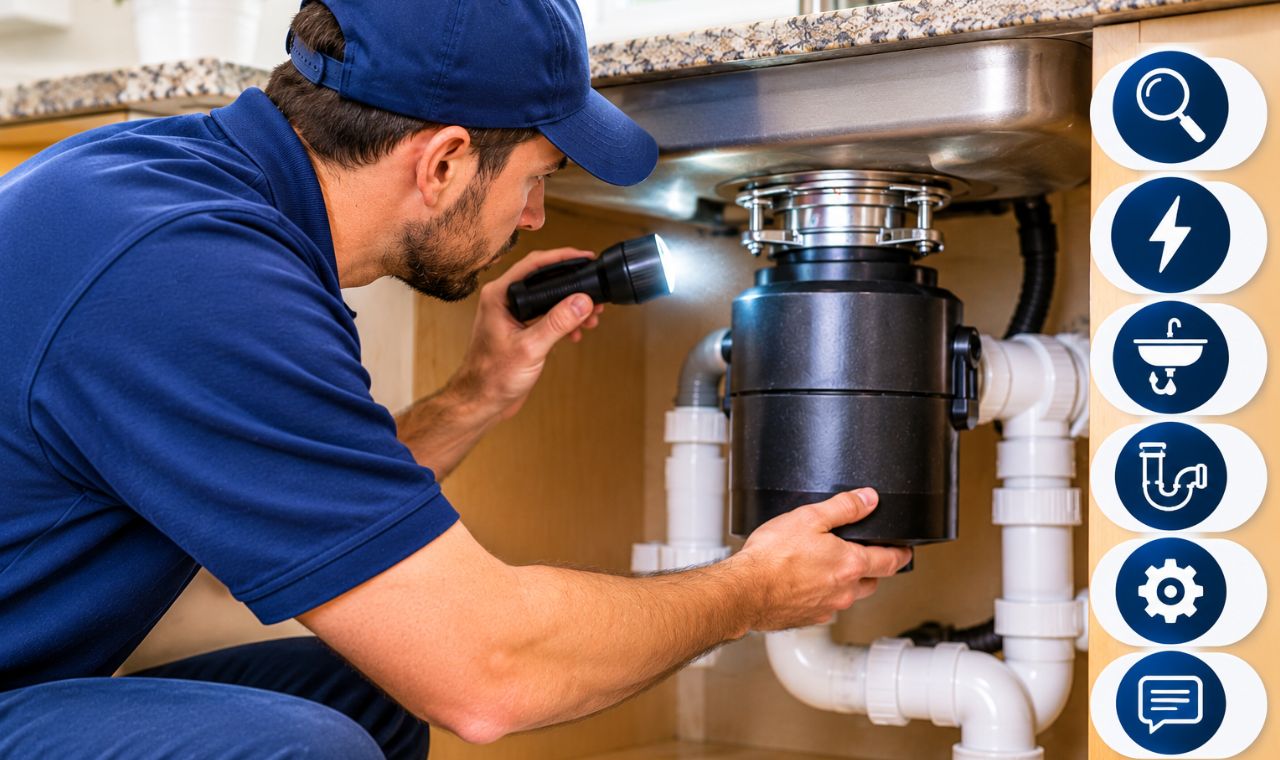
Basic troubleshooting has limits. Call a plumber if any of these apply:
- The disposal jams again and again.
- The reset button keeps tripping.
- The motor hums and the plate still will not turn after a careful attempt.
- The unit leaks from its housing or connections.
- You notice electrical trouble or a burning smell.
- The sink is still backed up after basic troubleshooting.
- More than one fixture has drainage problems.
A clogged garbage disposal that keeps returning has a cause you usually cannot see from the sink. A plumber can find it and tell you whether repair or replacement makes more sense. Royal Penguin Plumbing offers garbage disposal repair and installation for exactly these situations.
What should you do if the disposal leaks?
Turn the unit off, unplug it or shut off the breaker, and keep the area dry. A leak from a side connection may only need a tightened clamp or a new gasket. A leak from the bottom or the housing usually means a seal has failed or the casing has cracked, and those units generally need replacing. Do not keep using a clogged garbage disposal that is also leaking.
How can you tell the motor has failed?
Typical signs include a plate that turns freely with the wrench while the unit still will not run, a reset button that trips over and over, and silence after you have confirmed power and pressed reset. A burning smell is a reason to stop immediately. When a clogged garbage disposal turns out to be a dead motor, replacement is usually the practical answer.
How Does a Plumber Diagnose and Fix a Garbage Disposal Problem?
A professional visit is more than a quick look. Expect something like this:
- Inspecting the disposal for foreign objects and internal damage
- Checking electrical and mechanical operation safely
- Examining the sink drain and P-trap
- Working out whether the problem is the unit or the drain
- Deciding whether cleaning, repair, or replacement makes sense
- Explaining the options before any work starts
A clogged garbage disposal might need nothing more than a cleared jam, or it might need a new unit. The answer should come from the diagnosis, not a guess.
Julie Rappo called Royal Penguin Plumbing about a broken garbage disposal. Her review says Jimmy diagnosed the problem quickly, gave her multiple options, and replaced the unit using parts available on his truck. That is the sequence a homeowner should expect: diagnose first, discuss choices, then fix it.
Curtis Denlinger’s review covers a different job, a clogged and leaking sink. He reported that the team arrived on schedule, diagnosed the problem quickly, and fixed it before lunch.
How to Prevent Your Garbage Disposal from Clogging Again
Prevention is mostly habit. A few changes keep a clogged garbage disposal from becoming a regular event.
- Run water as your manufacturer recommends, during and after grinding.
- Feed scraps in manageable amounts rather than one big pile.
- Keep grease and cooking oil out of the sink. Wipe pans into the trash.
- Skip fibrous scraps and anything your manual lists as unsuitable, since models differ.
- Keep utensils and nonfood items out of the unit.
- Follow the cleaning steps in your manual as part of regular garbage disposal maintenance.
- Deal with slow drainage early, before it turns into a recurring clog.
Garbage Disposal Repair and Drain Cleaning in Bucks and Montgomery County
Royal Penguin Plumbing is a family-owned, licensed, and insured residential plumbing company based in Souderton, Pennsylvania.
We handle garbage disposal repair and installation, drain cleaning, kitchen plumbing services, and general plumbing for homes in Bucks and Montgomery County.
Whether you are dealing with a clogged garbage disposal, a slow kitchen drain, or a unit that needs replacing, we start by finding the actual cause.
We explain what we find in plain language and lay out your options before any work begins.
Our focus is honest communication, dependable workmanship, and helping homeowners understand their choices.
If you searched for an unclog drain service Cold Springs offers, call us first to confirm your address is within our service area.
You can contact Royal Penguin Plumbing through our website to ask about scheduling.
The Bottom Line
A clogged garbage disposal is easier to fix when you know what you are dealing with. A humming unit is usually jammed, a silent one has often lost power, and a full sink with a spinning disposal points to the drain. Handle the simple jams safely, then stop when the problem keeps returning or spreads to other fixtures.
Whether you are dealing with a stubborn kitchen blockage or evaluating different types of water heaters, like tankless, gas, or electric models, for a home upgrade, Royal Penguin Plumbing can look at your disposal, drain, or hot water system in Bucks and Montgomery County and explain your options clearly.
Frequently Asked Questions
Q. Why is my garbage disposal humming but not working?
The motor has power, but the grinding plate is stuck. Turn the unit off, cut power, and check for a trapped object. If it still hums after a careful attempt, the unit may need professional repair.
Q. Can a clogged garbage disposal cause water to back up in the sink?
Yes. A clogged garbage disposal or the drain behind it can leave water with nowhere to go, so it rises in the sink or the other basin. Stop running the unit, because more water makes the backup worse.
Q. Can a garbage disposal clog affect the main sewer line?
A clogged garbage disposal rarely affects the main sewer line on its own. If several fixtures back up together, the problem may sit deeper in the drainage system, and a plumber should inspect it.
Q. When should I call a plumber for a clogged garbage disposal?
Call if a clogged garbage disposal keeps jamming, the reset button keeps tripping, the unit leaks, or you smell burning. Also call if the sink stays backed up after basic steps or other drains show problems.
Q. Does Royal Penguin Plumbing provide garbage disposal repair and installation?
Yes. Royal Penguin Plumbing provides garbage disposal repair and installation for homeowners in Bucks and Montgomery County, along with drain cleaning and kitchen plumbing.